Before AI vs After AI: The Decade That Changed How We Learn
 By Narendra Dwivedi
4 July 2026
•
19 min read
By Narendra Dwivedi
4 July 2026
•
19 min read
TL;DR
A decade ago, learning depended on finding the right book, teacher, website, or forum. Today, AI has transformed learning into an interactive conversation where explanations adapt to the learner. This article explores how that shift has changed education, software development, and lifelong learning while explaining why AI complements, not replaces, human curiosity and critical thinking.
If someone asked me what has changed the most over the past decade, my answer probably wouldn't be smartphones, cloud computing, or even the incredible progress we've seen in artificial intelligence itself. I'd say the biggest transformation has been how we learn. That might sound surprising at first. After all, books still exist, universities still teach the same core subjects, and the internet continues to hold more information than any single person could consume in a lifetime. Knowledge hasn't suddenly appeared out of nowhere. What has changed is the relationship between people and that knowledge. The process of learning, which for decades depended on searching, waiting, and adapting to whatever resources were available, has quietly evolved into something far more personal and interactive. It is easy to forget how different things were only a decade ago. Learning wasn't just about understanding a concept. Before you could even begin understanding it, you first had to find someone—or something—that explained it in a way your mind could grasp. Sometimes that explanation came from a great teacher. Sometimes it came from a helpful senior, a friend who had already studied the subject, or an experienced colleague at work. More often, however, you were on your own, navigating through search results, textbooks, online forums, YouTube videos, and technical documentation, hoping that one of them would finally make everything click.
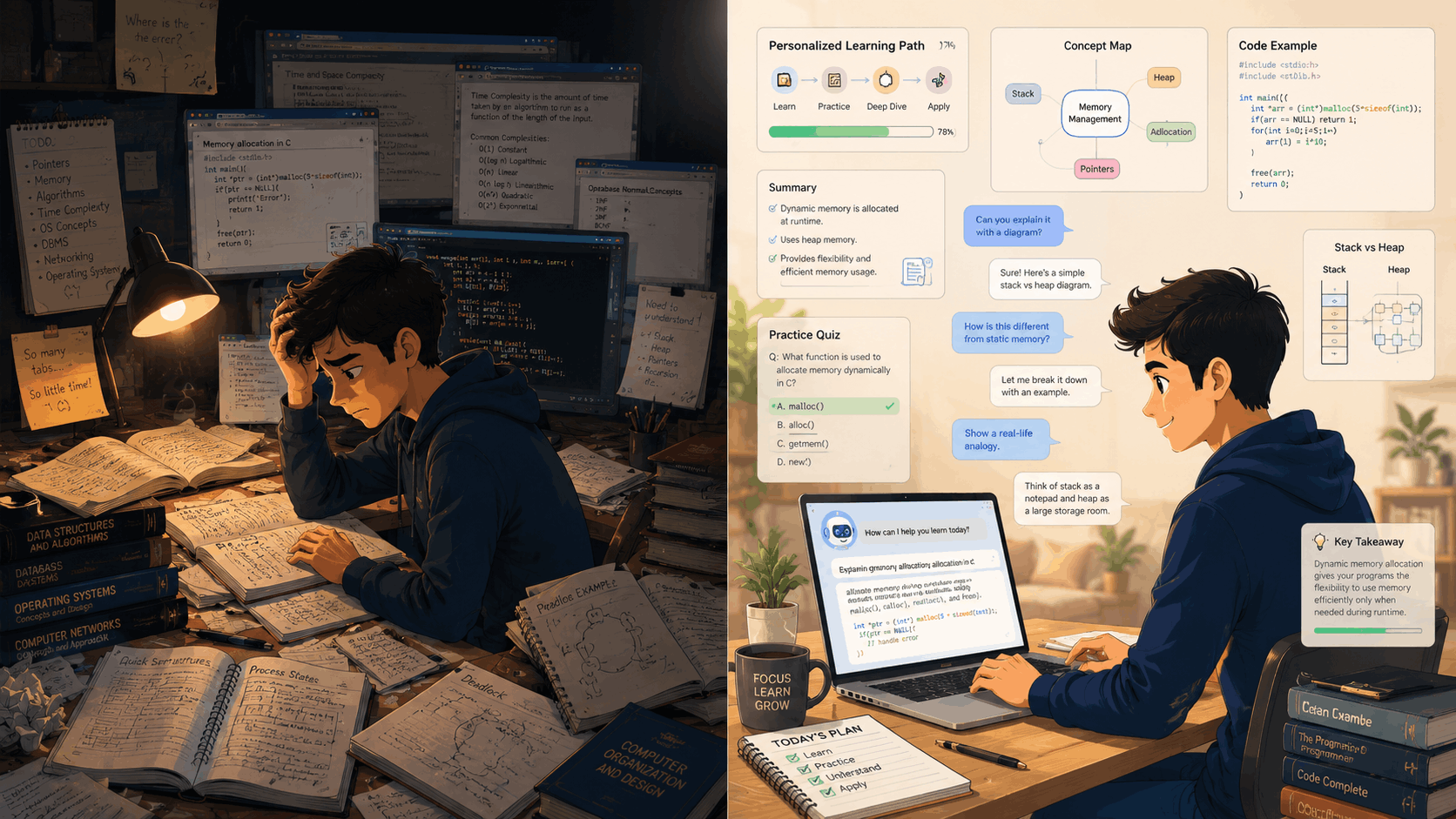
For software developers, this routine became almost second nature. A small programming error could easily consume an entire evening. You copied an error message into Google, opened multiple articles, compared different solutions, and eventually landed on a Stack Overflow discussion where someone had encountered a similar problem years earlier. Sometimes the accepted answer solved your issue immediately. Other times it raised even more questions because it assumed you already understood concepts you were still trying to learn. The experience wasn't limited to programming. Students preparing for computer engineering semester exams often found themselves in a remarkably similar situation. A single subject could require reading class notes, reference books, lecture slides, previous years' question papers, and countless online tutorials, not because one source was necessarily wrong, but because each explained the topic differently. If one explanation didn't resonate with you, your only option was to keep searching until you found another. And that wasn't always easy. Teachers have limited classroom hours and hundreds of students to guide. Seniors graduate, friends may not always be available, and not everyone explains concepts in a way that suits every learner. Books remain one of humanity's greatest inventions, but they can only teach through the perspective of their author. If the writing style matched the way you naturally thought, learning felt rewarding. If it didn't, you could spend hours rereading the same chapter and still struggle to connect the dots. Anyone who has prepared for engineering semester examinations will probably remember this feeling. You genuinely wanted to understand why an algorithm worked, how a microprocessor executed instructions, or what really happened inside an operating system when a process was scheduled. But the semester moved quickly, assignments piled up, and examinations arrived whether your understanding was complete or not. When time ran out, many students did what generations before them had done—they memorized. Not because they believed rote learning was the best approach, but because they had exhausted every resource they knew, and understanding simply hadn't arrived in time. Looking back now, one thing becomes clear. The biggest challenge wasn't a shortage of information. It was a shortage of explanations that matched the learner. That distinction is important because the internet was never empty. Libraries were full of books. Universities recommended excellent reference material. Documentation existed for almost every programming language, framework, and technology. Thousands of tutorials, blogs, discussion forums, and educational videos were freely available online. The real difficulty was that every one of those resources expected you to adapt to them.
If a textbook explained recursion using mathematical notation but you understood better through visual examples, the book couldn't change its approach. If a professor explained networking concepts in a highly theoretical manner while you learned best through practical analogies, the lecture continued regardless. Even online articles, despite being easier to discover, were static. They answered the questions the author expected readers to have, not necessarily the questions that were forming inside your own mind. That was simply how learning worked for generations. Nobody questioned it because there wasn't another option. Knowledge was abundant, but it wasn't flexible. The learner had to do all the adapting. Today, for the first time in history, that assumption is beginning to change. Instead of forcing ourselves to fit the explanation, we are gradually entering an era where the explanation can adapt to us. That shift may appear subtle on the surface, but it has fundamentally changed what it feels like to learn, whether you're writing your first line of code, preparing for an engineering semester exam, changing careers, or exploring a subject simply because curiosity led you there. And perhaps that is the most remarkable technological change of the past decade—not that information has become more abundant, but that it has finally become conversational.
From Searching for Answers to Having Conversations with AI
The biggest misconception about AI is that it simply provides answers faster than Google. Speed certainly matters, but it isn't the real revolution. The real change is that, for the first time, learning has become a conversation instead of a search. That distinction may seem subtle, yet it fundamentally changes how we approach almost every subject. Think about how learning traditionally worked. Every resource you used—a textbook, a blog, a YouTube tutorial, a university lecture, or even a Stack Overflow discussion—was designed as a one-way form of communication. The author explained a concept, and your job was to understand it. If you didn't, the responsibility fell entirely on you to look for another resource, another author, or another explanation. The resource never changed. You did. Artificial intelligence turns that relationship upside down. Instead of accepting a single explanation, you can now ask for another. And another. And another, until the concept finally makes sense. Suppose you're trying to understand database normalization. The first explanation might feel too technical. So you ask AI to simplify it. If that still feels abstract, you ask for a real-world analogy. Perhaps libraries make more sense to you than databases, so you ask AI to explain normalization as though it were organizing books on shelves. Maybe you learn best through sports. You ask it to explain the same concept using a cricket team, where every player has a specific role and information isn't unnecessarily repeated across multiple scorecards. Or perhaps you're preparing for an interview rather than an examination. Now you don't need a beginner's explanation at all. Instead, you ask AI to focus on practical interview questions, common mistakes, and real-world scenarios that companies actually care about. The concept hasn't changed. The explanation has. That simple difference is far more significant than it appears. For generations, students adapted themselves to the available explanation. Today, the explanation adapts itself to the learner. That wasn't possible before.
Every Learner Thinks Differently
One of the greatest assumptions traditional education made was that everyone could learn effectively from the same explanation. Reality has never worked that way. Some people understand ideas through diagrams. Others prefer stories. Many engineers feel comfortable with equations, while someone else may only understand the mathematics after seeing a practical example first. Some learners want every intermediate step explained carefully. Others become impatient unless they reach the advanced concepts quickly. None of these approaches are right or wrong. They're simply different. Unfortunately, most educational resources couldn't account for those differences. A textbook couldn't notice that you were struggling with a particular paragraph and decide to explain it differently. A recorded lecture couldn't pause itself because you looked confused. Documentation couldn't suddenly replace technical terminology with simpler language because you happened to be learning the topic for the first time. AI changes that dynamic in a surprisingly natural way. You can ask it to explain a concept as though you're completely new to the subject. You can ask it to increase the technical depth once you've understood the basics. You can request visual descriptions, practical examples, analogies from everyday life, historical context, interview-focused explanations, or even comparisons between two competing ideas. If English isn't your strongest language, you can ask it to explain the same concept in simpler English or even another language entirely. If one explanation doesn't work, nothing stops you from asking again. There is no embarrassment. There is no feeling that you're slowing down the rest of the classroom. There is no hesitation about asking what might seem like a "basic" question. For many learners, that psychological freedom is just as valuable as the information itself.
Learning Doesn't Stop at the First Explanation
Perhaps one of the most underrated advantages of AI is that it encourages curiosity instead of ending it. In the past, finding the answer often marked the end of the learning process. Once you located the relevant chapter or finally discovered the Stack Overflow post that solved your coding problem, you moved on. Now, solving the original problem is often just the beginning of a deeper conversation. You can ask why that solution works instead of another. You can explore alternative approaches. You can deliberately challenge the explanation by asking what would happen under different conditions. You can ask AI to point out common misconceptions before you accidentally develop them yourself. You can even ask it to quiz you, create practice problems, identify weaknesses in your understanding, or explain the same concept from the perspective of another field. Imagine learning recursion. A textbook explains recursion through mathematical functions. AI can certainly do that too. But it can also explain recursion using nested Russian dolls (also known as Matryoshka dolls, where each doll contains a smaller version of itself), folders inside folders on your computer, family trees, or even a person standing between two mirrors. If none of those analogies resonate with you, you simply ask for another until one does. The explanation evolves as the conversation evolves. For decades, learners had to search until they found the right explanation. Today, they can help create it.
The World's Most Patient Tutor
One of the biggest barriers to learning has never been intelligence. It has been hesitation. Many students have experienced the feeling of wanting to ask another question in class but deciding against it because everyone else seemed to understand. Others have avoided asking seniors or teachers the same doubt twice because they worried about appearing inattentive. Even experienced professionals sometimes hesitate to ask what they fear might be considered an "obvious" question. AI quietly removes much of that hesitation. It doesn't become impatient if you ask the same question five different times. It doesn't judge your pace. It doesn't mind beginning again from the basics after spending twenty minutes discussing advanced concepts. It simply continues the conversation. That doesn't replace teachers, mentors, or experienced colleagues. If anything, it makes those interactions more meaningful because learners can arrive with stronger foundations and better questions. Perhaps that is the real contribution of AI to education. Not that it knows everything. But that it never gets tired of helping someone understand.
Learning Is No Longer Limited to Classrooms or Careers
Although software development and engineering provide some of the clearest examples of this shift, the impact of AI extends far beyond writing code or preparing for semester examinations. In many ways, it has changed what it means to be a learner. A decade ago, deciding to learn something completely new often came with an unexpected obstacle: you first had to figure out where to begin. If you wanted to study photography, should you buy a book or enroll in an online course? If you wanted to understand personal finance, which blog could you trust? If you decided to learn Python, which tutorial was suitable for a beginner and which assumed you already knew programming? Finding a reliable starting point was often as challenging as learning the subject itself. Today, that uncertainty has become much smaller. Someone interested in photography can ask AI to explain aperture, shutter speed, and ISO using everyday examples before ever touching a camera. Someone learning a new language can practice conversations at their own pace without worrying about making embarrassing mistakes. A professional thinking about switching careers can explore unfamiliar industries, understand new terminology, and build confidence before investing in expensive courses or certifications. The first step has become easier, and that matters because beginning is often the hardest part of learning anything. Curiosity no longer stops with the question, "Where do I even start?" Instead, it moves naturally toward, "Help me understand this." That is a remarkably different experience.
Knowledge Has Become More Reachable
One of the quietest but most significant changes brought about by AI is that knowledge feels more accessible than ever before. Not because information was hidden in the past, but because understanding often depended on circumstances beyond our control. Perhaps you had an excellent teacher who inspired you. Perhaps you didn't. Perhaps your college library had the right books. Perhaps it didn't. Maybe you lived in a city where workshops, coaching centers, and experienced mentors were easy to find. Or perhaps you lived somewhere those opportunities were limited. The quality of our learning was often shaped by geography, timing, finances, and access to experienced people. While AI cannot eliminate those differences entirely, it reduces their influence in meaningful ways. A student in a small town can now explore machine learning, economics, astronomy, philosophy, or software engineering with explanations that would once have required access to specialists, expensive coaching, or well-stocked libraries. A working professional can learn after office hours without worrying about classroom schedules. Someone returning to education after many years no longer has to feel left behind because they can revisit forgotten fundamentals without hesitation. For millions of people, the gap between curiosity and understanding has become significantly smaller. That may be one of the most important educational changes of our generation.
AI Doesn't Make Learning Easy. It Makes Learning Possible.
There is a common criticism that AI makes people lazy. Like many debates surrounding new technology, the reality is more nuanced. AI certainly makes it easier to obtain information, but obtaining information has never been the same as understanding it. A calculator didn't eliminate the need to learn mathematics. Search engines didn't eliminate the need to think critically. Likewise, AI doesn't remove the need to practice, experiment, fail, and develop genuine understanding. A software developer who copies AI-generated code without reading it will still struggle when that code behaves unexpectedly. A student who memorizes AI-generated notes without understanding the underlying concepts may perform well in a short quiz but will almost certainly face difficulties later when those concepts become building blocks for more advanced topics. Learning has always required effort. AI doesn't remove that effort. It removes unnecessary friction. There is an important difference between spending three hours understanding a concept and spending three hours trying to find an explanation that suits your level of knowledge. The first is productive struggle. The second is often avoidable frustration. AI allows learners to spend more time wrestling with ideas and less time searching for someone who can explain those ideas clearly. That is a far better use of a learner's energy.
The Responsibility That Comes With Better Tools
Every major technological advancement has changed not only what people can do but also what they are responsible for doing. Search engines made information easier to find, but they also made misinformation easier to spread. Social media connected billions of people while introducing entirely new challenges around attention and trust. Artificial intelligence is no different. Its greatest strength is also one of its biggest risks. AI often presents information with remarkable confidence, even when parts of that information may be incomplete, outdated, or occasionally incorrect. Because of that, learners cannot afford to accept every response without reflection. Critical thinking has become more important, not less. Perhaps the most valuable habit in the age of AI is learning to ask one additional question. "How do we know this is true?" That simple habit encourages learners to compare sources, verify facts, read documentation, and continue thinking instead of accepting every answer at face value. The goal should never be to replace human judgment with artificial intelligence. The goal is to combine both. AI can accelerate learning, but curiosity, reasoning, experimentation, and experience remain deeply human qualities. Those are the skills that transform information into understanding and understanding into wisdom.
The New Skill Isn't Searching : It's Asking Better Questions
For much of the internet's history, being good at learning often meant being good at searching. Experienced developers knew how to craft the right Google query. Researchers knew which books to read and which journals to trust. Students learned which websites explained concepts more clearly than others. Finding the right resource was a skill in itself. That skill hasn't disappeared, but it is no longer the only one that matters. Today, one of the most valuable abilities is knowing how to ask thoughtful questions. The quality of the answer you receive from an AI assistant often depends on the quality of the question you ask. A vague prompt usually produces a vague explanation, while a well-structured question can transform a confusing topic into something surprisingly easy to understand. This is why prompt writing, although often discussed as a technical skill, is really a learning skill. It encourages curiosity, precision, and critical thinking. It teaches us to identify exactly what we don't understand instead of simply saying, "I don't get it." In many ways, AI is encouraging people to become more active participants in their own learning rather than passive consumers of information.
What the Next Generation May Never Experience
Students beginning their educational journey today may never fully understand what learning felt like before conversational AI became widely available. They may never know the frustration of spending an evening opening dozens of browser tabs because every article explained the same topic differently. They may never experience waiting days to ask a teacher a follow-up question or hoping someone on an online forum would eventually reply to a post. For them, asking a follow-up question will feel completely natural. They will expect explanations to become simpler when requested, examples to change when they don't relate, and concepts to be revisited as many times as necessary. What seems revolutionary to us may simply feel normal to them. History is full of technological changes that eventually became invisible. Few people today stop to admire electric lights every evening or think about how extraordinary it is to speak instantly with someone on the other side of the world. Once a technology becomes part of everyday life, we stop noticing it. Artificial intelligence may follow the same path. Years from now, people may not remember a time when learning meant searching through endless resources hoping that one of them happened to explain a concept in the right way. Instead, they'll expect knowledge to respond.
AI Doesn't Replace Teachers. It Changes What Teaching Can Be
One concern that often appears whenever AI is discussed is whether it will replace teachers, professors, mentors, or trainers. That question misses something important. The best teachers have never been valuable simply because they possessed information. Books have contained information for centuries, and the internet made that information available to billions of people long before modern AI existed. Great teachers are valuable because they inspire curiosity, encourage critical thinking, provide context, recognize when students are struggling, and help learners build confidence. Artificial intelligence cannot replace those human qualities. What it can do is reduce the time spent on repetitive explanations, answer routine questions, provide additional practice outside the classroom, and allow students to arrive with stronger foundations. Instead of replacing teachers, AI has the potential to make human teaching even more meaningful by allowing classroom time to focus on discussion, creativity, collaboration, and problem-solving rather than repeatedly covering the same basic concepts. Perhaps the future of education is not humans versus AI. Perhaps it is humans with AI.
Looking Back and Looking Ahead
Only a decade separates the world before conversational AI from the one we live in today, yet the difference in how we approach learning is remarkable. Not because human intelligence has changed. Not because books have become less valuable. Not because teachers have become less important. The transformation lies somewhere much simpler. For generations, learning depended on finding the right explanation. Today, we can ask for an explanation that fits the way we learn. That single change has quietly altered education, software development, professional training, career transitions, and self-learning in ways that would have seemed almost impossible not very long ago. There is still hard work involved in mastering any subject. There always will be. Understanding complex ideas requires patience, practice, mistakes, and persistence. Artificial intelligence cannot replace those experiences because they are fundamental to how humans learn. What AI can do is remove unnecessary barriers between curiosity and understanding, It gives us the freedom to ask one more question. Then another. And another. Without feeling rushed. Without feeling judged. Without wondering whether we are asking something too simple. That may be the most meaningful change of all. The greatest contribution of artificial intelligence isn't that it has all the answers. It is that, for the first time in history, millions of people have access to a learning companion that is willing to explain the same idea in ten different ways until understanding finally arrives. Knowledge has not become smaller. Our distance from it has. And perhaps, years from now, when people look back at this decade, they won't remember it simply as the decade when AI became mainstream. They'll remember it as the decade when learning stopped being a treasure hunt and started becoming a conversation.
Narendra Dwivedi
Author