The "Thappa" Paradox: Why We Traded Human Corruption for Algorithmic Authority
 By Narendra Dwivedi
7 July 2026
•
17 min read
By Narendra Dwivedi
7 July 2026
•
17 min read
TL;DR
The journey from the ink thappa to digital fingerprint authentication was more than a technological upgrade. It transformed how society establishes trust. While paper-based systems were vulnerable to forgery, corruption, and exploitation, modern biometrics have made identity verification faster and more secure. Yet this shift also raises important questions about privacy, transparency, data governance, and what happens when technology fails to recognize the very person it was designed to identify. The fingerprint never changed. Our trust in the systems around it did.
There was a time when proving your identity required nothing more than a thumb dipped in ink. For generations, millions of people who couldn't read or write would press their thumb onto paper as a signature. That small black impression, commonly called a thappa in many parts of India, appeared on land records, loan papers, pension documents, contracts, government forms, and countless other pieces of paperwork. It wasn't just a mark on paper. It represented consent, ownership, identity, and sometimes even a person's future. Looking back, the system seems surprisingly simple. There were no scanners, encrypted databases, cloud servers, or biometric sensors. Just paper, ink, and a thumb. Yet simplicity never meant perfection.
A thumb impression could be forged. Documents could be altered. Unscrupulous middlemen could exploit people who were unable to read what they were signing. Corrupt officials could manipulate records. Entire disputes over land, inheritance, or benefits sometimes revolved around whether a thumb impression was genuine or obtained under questionable circumstances. The thappa itself was only one part of the story; the real challenge was the human system surrounding it. Over time, technology promised something better.
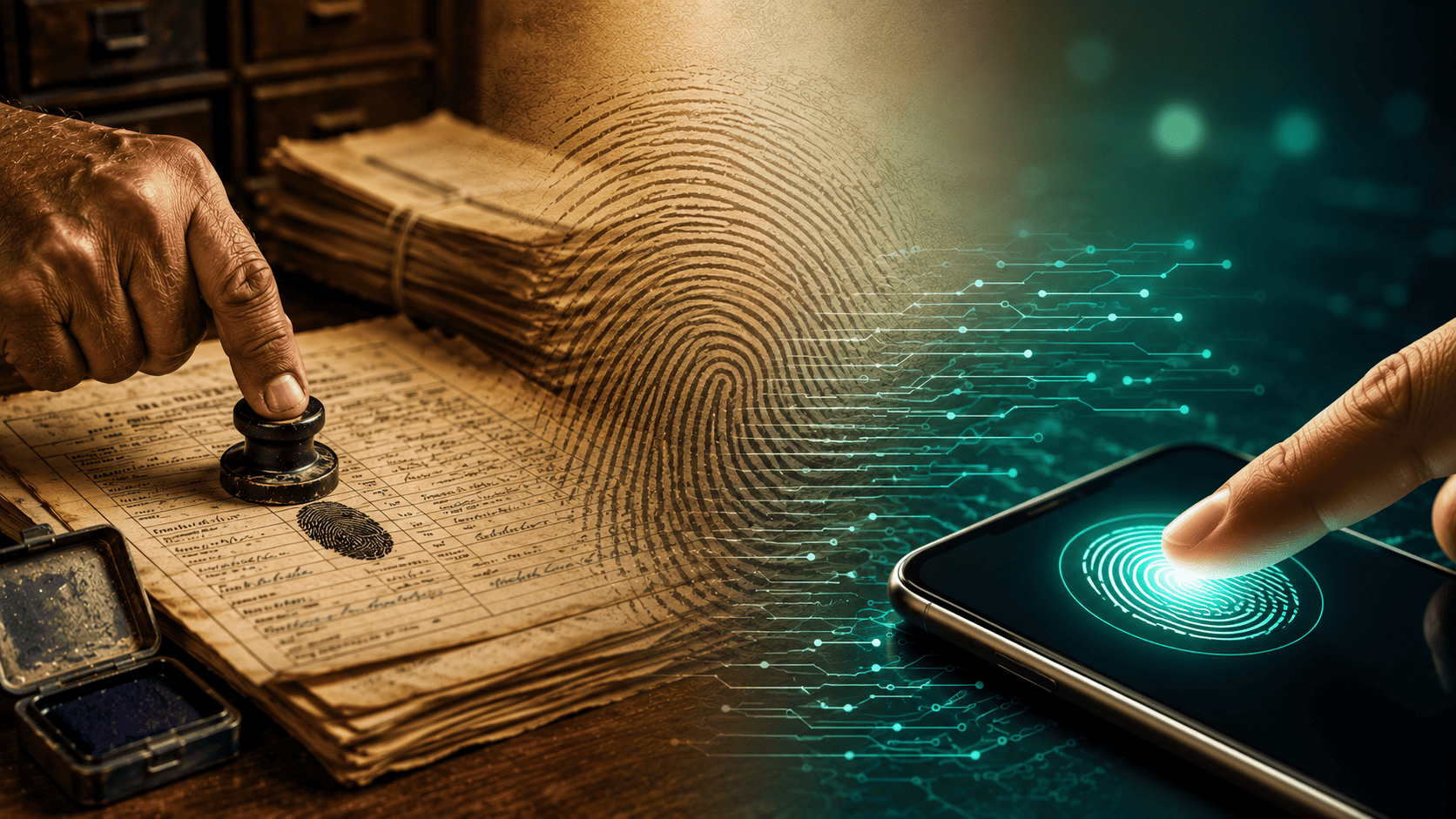
Instead of trusting ink on paper, we began trusting machines. Fingerprint scanners replaced ink pads. Biometric authentication entered smartphones, office attendance systems, banking services, airports, and digital identity platforms. A fingerprint was no longer just an impression left behind—it became a digital credential capable of unlocking doors, approving transactions, and verifying identity within seconds. At first glance, it feels like an obvious improvement. After all, copying a thumb impression from paper is far easier than fooling a modern biometric system. Digital authentication has undoubtedly reduced many forms of impersonation and made identity verification faster, more convenient, and often more secure. But every technological leap quietly changes something beyond the technology itself. It changes where we place our trust. In the era of the thappa, trust rested largely with people—officials who verified documents, witnesses who confirmed identities, and institutions responsible for maintaining records. Today, that trust increasingly rests with fingerprint sensors, software, databases, security chips, network infrastructure, and algorithms that decide whether two fingerprints belong to the same person. The fingerprint, interestingly, has remained the only constant throughout this journey. The ridges on our fingers haven't changed. What has changed is the system interpreting them—and with it, the authority to decide who we are.
This article isn't an argument for returning to ink and paper, nor is it a criticism of every biometric system. Modern digital authentication has solved problems that older methods struggled with for decades. But every solution brings new trade-offs, and every generation inherits a different set of risks. The story of the thappa is, therefore, not merely the history of fingerprints. It is the history of how society chooses to trust—and what happens when that trust shifts from human judgment to technological systems.
When a Thumbprint Was More Than Just Ink
Long before fingerprint sensors found their place on smartphones and laptops, fingerprints were already deeply woven into everyday administration. Across villages, towns, courts, banks, and government offices, a thumb impression often carried the same legal weight as a handwritten signature. For many people, especially those who could not write their names, the thappa wasn't an alternative—it was their identity on paper. Its widespread use wasn't accidental. A signature can change over time and, with enough practice, can even be imitated. A thumbprint, on the other hand, offered something that appeared unique to every individual. Long before digital biometrics existed, governments and institutions recognized that the intricate ridges on a person's finger could serve as a practical way to distinguish one individual from another. Ink simply became the medium through which that uniqueness was captured. But the thappa was never a complete identity system by itself. Imagine visiting a government office several decades ago. An official would examine your document, compare records, ask questions, perhaps call witnesses, and rely on experience before accepting a thumb impression. The ink mark certainly mattered, but so did the surrounding context. Identity wasn't established by a fingerprint alone—it was supported by people, paperwork, and institutional processes. That human element was both the system's greatest strength and its greatest weakness. When everyone involved acted honestly, the process could accommodate situations that rigid systems often struggle with today. A damaged thumb, a faded impression, or a smudged document did not automatically end the conversation. There was still room for explanation, verification, and discretion. Unfortunately, the same flexibility also created opportunities for abuse.
History is filled with stories of vulnerable people unknowingly placing their thumb impression on documents they could not read. Unscrupulous agents, forged records, fraudulent land transfers, fabricated agreements, and corruption exploited not just the ink on the paper but also the imbalance of knowledge between those preparing the documents and those signing them. In many cases, the fingerprint itself wasn't fake—the circumstances surrounding its use were. That distinction is important. The weakness of the thappa era wasn't that fingerprints were unreliable. Human fingerprints have always been remarkably unique. The weakness lay in everything around the fingerprint: paper could be replaced, records could disappear, officials could be bribed, and individuals with little education or legal awareness could be manipulated into giving consent they never truly intended. Yet even with all its flaws, the system retained one characteristic that often goes unnoticed today. Every important decision still passed through another human being. A clerk could ask another question. A magistrate could examine additional evidence. A bank manager could recognize a familiar customer despite an unclear thumb impression. A local official might know the family standing before them. These human judgments were far from perfect and, at times, deeply susceptible to prejudice or corruption. But they also allowed exceptional circumstances to be understood in ways that paper alone never could. As societies grew larger, populations became more mobile, and public services expanded to millions of people, depending solely on human judgment became increasingly difficult. Governments and organizations needed faster, more consistent ways to verify identity across cities, states, and even countries. Paper records were no longer enough. The search for a more reliable system had already begun—not because the fingerprint had failed, but because the world around it had changed.
The Digital Promise: Why We Moved Beyond the Ink Pad
The transition from paper thumb impressions to digital biometrics did not happen overnight, nor did it happen without reason. It was driven by a problem that had become increasingly difficult to ignore: modern societies had simply outgrown systems that depended heavily on paper records and manual verification. Imagine trying to verify the identity of millions of people every day using nothing more than documents, signatures, and human memory. Banks serve customers across thousands of branches. Government departments manage welfare schemes covering entire populations. Companies operate offices in multiple cities, while smartphones have transformed personal security into something we carry in our pockets. The scale is unlike anything the paper era was designed to handle. Digital biometrics offered an elegant answer.
Instead of asking Does this signature look genuine ? or Is this really the same person ? , a fingerprint scanner could compare biometric characteristics within seconds. A process that once depended on visual inspection and personal judgment became faster, more consistent, and far more difficult to manipulate through traditional methods. The impact was visible almost everywhere. A fingerprint could unlock a smartphone without remembering another password. Employees could mark attendance without relying on registers that someone else might sign. Banks and financial institutions gained another layer of protection against unauthorized access. Public services began using biometric verification to reduce duplicate identities and the long-standing problem of ghost beneficiaries or ghost workers, records that existed on paper but did not always represent real individuals. None of this happened because fingerprints suddenly became more unique. They were already unique long before computers existed. What changed was our ability to capture, compare, and verify them almost instantly using digital technology. For most people, the experience became so seamless that biometric authentication quickly blended into everyday life. We unlock our phones with a touch, authorize payments, secure sensitive applications, enter workplaces, and access services without giving much thought to the technology working in the background. What once required ink, forms, and patient verification now takes less than a second. That convenience is real, and so are the security improvements. Compared with traditional paper-based systems, modern biometric authentication has made many common forms of impersonation significantly more difficult. It has reduced dependence on easily forgotten passwords in some situations and helped organizations verify identity at a scale that would have been almost impossible through manual processes alone. It would be unfair to ignore these achievements.
In many ways, digital biometrics solved exactly the problems they were designed to solve. They reduced opportunities for certain kinds of fraud, accelerated verification, and brought a level of consistency that paper records could rarely provide. If this were the whole story, the evolution from the thappa to the fingerprint sensor would simply be another example of technology making life better. But every system, no matter how advanced, changes more than just the process. It changes the assumptions we make. In the paper era, a thumb impression was one piece of evidence among many. Today, a successful fingerprint match often becomes the evidence. Increasingly, we don't ask whether the person standing before us is genuine—we ask whether the system agrees. That is a subtle change, but an important one. The greatest transformation brought by digital biometrics wasn't that fingerprints became digital. It was that authority gradually shifted away from human interpretation and toward technological systems. The scanner, the software, the database, and the algorithm became silent participants in decisions that were once made almost entirely by people. And that raises a new set of questions—not about fingerprints themselves, but about the technology entrusted to interpret them.
Beyond the Fingerprint: What Happens After You Touch the Sensor?
For most of us, biometric authentication lasts only a second. We place a finger on a sensor, hear a subtle click or vibration, and move on. Whether it is unlocking a smartphone, accessing a banking application, entering an office, or verifying identity for a public service, the interaction feels almost effortless. But that single touch is only the beginning of a much larger process. Unlike an ink thumb impression left on paper, a digital fingerprint must be captured, processed, compared, and interpreted by technology. What happens next depends entirely on the system behind it. There is no single architecture that every biometric device follows. For example, many modern smartphones are specifically designed so that fingerprint information remains inside a secure hardware component on the device itself. The fingerprint is not available to ordinary apps, and the authentication process is intentionally isolated to protect user privacy. This design allows you to unlock your phone without exposing your fingerprint to every application you install. However, not every biometric system works this way. A fingerprint scanner used in an office attendance system is very different from one built into a smartphone. A biometric device used at a government office may follow a different design from one used at a private company. Some systems compare fingerprints locally, while others communicate with external servers. Some retain biometric templates for future verification, while others may have different retention policies depending on legal requirements, organizational needs, or system design.
The important point is not that one approach is always better than another. The important point is that every additional layer of technology introduces new questions.
- Who operates the system?
- How long is biometric information retained?
- Who is responsible for protecting it?
- Can the data be used for purposes beyond authentication, if the applicable policies or laws allow it?
- How transparent are those policies to the people whose fingerprints are being collected?
These questions rarely crossed anyone's mind during the era of the ink thappa. A thumb impression on paper certainly had its own risks, but its existence was obvious. You could see the document, hold it in your hand, and understand where your thumb impression had been placed. Digital systems are different because much of their operation is invisible. Most users never see how their fingerprint is processed. They cannot inspect the software making the comparison. They do not know whether the system stores a raw image, a biometric template, or nothing beyond the immediate authentication process. They simply trust that the technology has been designed responsibly. In many cases, that trust is well placed. Engineers, security researchers, and organizations invest significant effort into protecting biometric systems from misuse. Strong encryption, secure hardware, and carefully designed authentication mechanisms have made modern devices remarkably secure. Yet technology is not immune to mistakes. Software can contain bugs. Hardware can fail. Networks can experience outages. Security vulnerabilities may be discovered years after a system has been deployed. Human errors during implementation or configuration can create weaknesses that were never intended by the original designers. Then there is another possibility that receives less attention. A fingerprint may be perfectly genuine, but the system may still fail to recognize it. The reasons can vary. A person's fingerprints may become difficult to read because of age, manual labor, skin conditions, injuries, moisture, or sensor quality. Different devices may perform differently. Even the threshold chosen by a recognition algorithm can influence whether a fingerprint is accepted or rejected. Unlike paper records, these decisions happen in milliseconds, often without any explanation. The screen simply displays a message.
- Fingerprint not recognized
- Authentication failed
- Match failed
For the machine, the process has ended. For the person standing in front of it, the conversation may only be beginning. And that raises perhaps the most important question of all. When technology becomes the authority that verifies identity, what happens when the authority makes a mistake?
When the Machine Says "No": The New Face of Authority
There is an old saying that rules are only as fair as the people who enforce them. For centuries, identity verification followed the same principle. Whether it involved a thumb impression, a handwritten signature, or a stack of documents, there was almost always another human being at the other end of the process. Sometimes that was a strength, sometimes it was a weakness.
A dishonest official could abuse power. A forged document could pass unnoticed. A vulnerable person could be manipulated into placing a thumb impression on a paper they did not fully understand. Human judgment was capable of empathy, but it was equally capable of bias, corruption, and error. Digital systems were expected to reduce those uncertainties. Machines do not accept bribes. Algorithms do not recognize social status. A fingerprint scanner does not know whether the person standing in front of it is rich or poor, influential or unknown. In principle, everyone is measured against the same criteria. That consistency is one of the greatest strengths of technology. Yet consistency is not always the same as fairness. Imagine an elderly farmer whose fingerprints have faded after decades of manual labor. Consider a construction worker with rough skin, or someone recovering from an injury to their hand. Their identity has not changed, but the sensor may struggle to read what nature has slowly altered. The machine is not acting with prejudice. It is simply operating within the limits of its design. The outcome, however, can feel exactly the same to the person being rejected. In the paper era, an official might have asked additional questions, checked supporting documents, or called someone who knew the individual personally. That approach was slower and far from perfect, but it left room for conversation. A machine cannot have that conversation. It only compares what it sees against what it expects to see. This is where the nature of authority quietly changes. Earlier, a person could disagree with another person. Today, they often find themselves disagreeing with a system. The challenge is not that technology is incapable of making accurate decisions. In fact, modern biometric systems are remarkably accurate in many situations. The challenge is that the reasoning behind those decisions is rarely visible to the person affected by them. If an application displays Match Failed, what exactly failed?
- Was the sensor dirty?
- Was the finger placed incorrectly?
- Did the software apply a strict matching threshold?
- Was there a temporary communication problem?
- Or was there another technical issue entirely?
Most users never know. The machine delivers a result, but not always an explanation. This is not unique to fingerprint authentication. Similar questions appear wherever algorithms assist in making decisions. Credit applications, automated fraud detection, facial recognition, and many other systems increasingly rely on software to evaluate situations that once depended entirely on people. Technology has made these processes faster and more consistent, but it has also created a new expectation that the machine's answer is somehow more objective than a human's. Sometimes it is, sometimes it is not. Technology reflects the quality of its design, the data it works with, and the decisions made by the people who build and operate it. It can reduce certain forms of human error while introducing entirely different kinds of technical limitations. Perhaps that is the real paradox. We spent decades trying to reduce the influence of unreliable human judgment, only to discover that every automated system still depends on human choices. People decide how software is written. People choose the matching thresholds. People define security policies. People determine how long biometric information is retained and what happens when authentication fails. The authority may appear digital, but its foundations are still deeply human. The question, therefore, is not whether we should trust people or trust machines. The question is whether we have designed systems that know when to trust both. Because the goal of identity verification has never been to prove that a machine is correct. The goal has always been to recognize the right person.
Conclusion: The Fingerprint Never Changed
History often remembers technology by the tools it introduced. We remember the printing press, the telephone, the internet, and now artificial intelligence. Yet the most significant changes rarely come from the tools themselves. They come from the quiet shift in where society chooses to place its trust. The story of the thappa is one such example. A century ago, a thumb impression represented identity through ink, paper, and the people responsible for verifying it. Today, the same fingerprint travels through sensors, software, secure hardware, databases, and algorithms before it becomes a simple message on a screen. The ridges on our fingers have not evolved. our systems have. It would be easy to romanticize the past or fear the future, but neither tells the complete story. Paper records created opportunities for forgery, corruption, and exploitation. Digital biometrics have helped reduce many of those problems while introducing new questions about privacy, transparency, data governance, and what happens when technology reaches the wrong conclusion. Neither world was perfect. One trusted people who could sometimes be dishonest. The other increasingly trusts technology that can sometimes be wrong. Perhaps that is the real lesson. Progress is rarely about eliminating problems. More often, it is about replacing old problems with new ones, then deciding which set of trade-offs society is better equipped to manage. As biometric authentication becomes part of everyday life, from unlocking phones and authorizing payments to accessing workplaces and public services, the conversation should not be limited to whether the technology works. It should also include how it fails, how those failures are corrected, and whether people have meaningful ways to challenge decisions that affect their lives.
Technology earns trust not because it is digital, but because it is transparent, accountable, and designed with people in mind. The paradox of the thappa is not that paper gave way to pixels.
It is that, without fully noticing, we shifted the authority to define identity from human judgment to technological systems. Whether that makes society fairer, safer, or simply different is a question that will continue long after today's scanners have been replaced by tomorrow's innovations. One thing, however, has remained remarkably constant through every generation. The fingerprint never changed. Only our faith in the systems built around it did.
Narendra Dwivedi
Author